From lockdown relief to a supported project in 2024, the foundation’s record is practical: training, community advocacy, household support and the strengthening of women’s own groups.
2024 · Supported by Womankind Worldwide
Bridge and Thrive
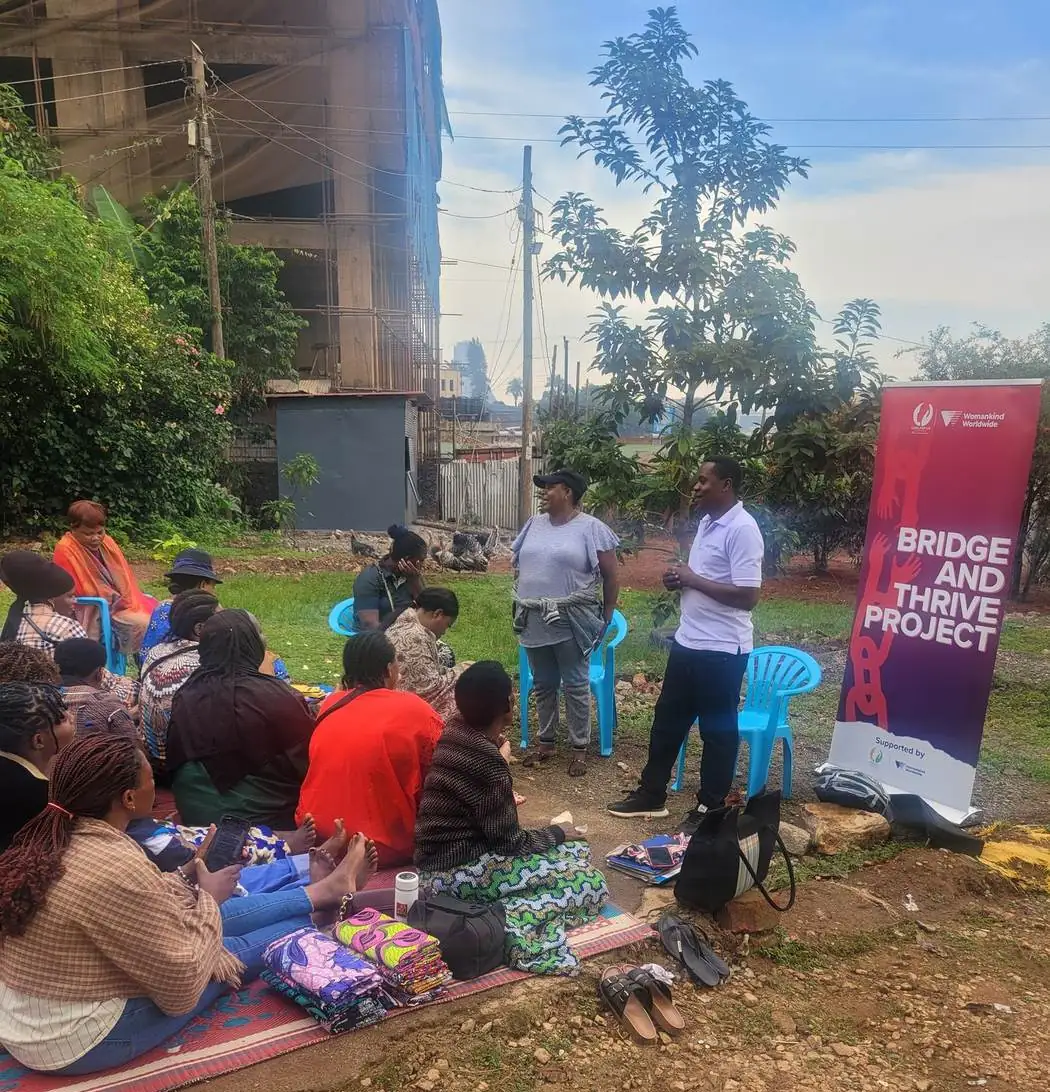
The Bridge and Thrive Project strengthened the knowledge, agency and resilience of women and girls in targeted communities. It engaged adolescent girls, young women and female sex workers through training on the trends, risks and prevention of trafficking in persons, including how vulnerability arises and where support can be found.
The same project carried advocacy on women’s rights to health, safe livelihoods and economic rights. Community awareness addressed gender-based violence and electronic or technology-facilitated gender-based violence, so that participants could name risks, prevention and the routes to assistance.
The partnership with Womankind Worldwide is the foundation’s principal supported engagement to date, and the standard it is building toward for future collaborations: a defined community, a clear protection and rights content, and activities held in the places women already gather.
An outdoor session under the project banner.
Kampala and Wakiso
Skills, enterprise and household finance
The foundation has trained refugee women, adolescent girls and young women, and stay-at-home mothers in practical vocational skills, financial management and entrepreneurship. Skills are not left standing alone. Sessions include basic business knowledge, household financial planning, savings, enterprise development and links to economic opportunities that already exist in the community.
The point of the training is resilience that a household can use: a skill that can be practised, a clearer view of money, and a connection to other women doing the same work.
Participants in a structured learning session.
Kisenyi · Women’s savings
The Blessed Group
Savings groups are one of the foundation’s routes to financial resilience. In Kisenyi, CFUG collaborates with the Blessed Group of women to strengthen savings practice and improve access to credit. Women pool resources, keep a discipline of contribution, and open small-scale capital for household and livelihood needs.
The model is deliberately local. It depends on the group’s own trust and records, with the foundation supporting the practice rather than replacing it.
Women gathered after a foundation activity.
From the first months
Practical support, then a programme
Before the work had a project name, members were already moving household items to female sex workers, single mothers and women in roadside business, and scholastic materials to families in low-income settlements. That direct assistance is still part of the organisation’s character. It is also the reason the later programmes insist on being useful in ordinary life, not only instructive.
Community engagement now runs through grassroots women’s groups, community leaders, civil society organisations and service providers. Those relationships are how participants are identified, how activities are hosted, and how referral and support networks are kept current.
A community session in the open.
Strategic direction
What the foundation is building toward
The next period is for consolidation. Grassroots experience is being shaped into programmes that can be planned, monitored and reported, and that still belong to the women who use them. The priorities are economic resilience, protection and rights awareness, access to skills and finance, and a stronger voice for women in community and civic processes.
Resource mobilisation, partnerships, the capacity of women-led groups, and evidence taken from community experience are the instruments. The foundation is explicit that its systems for finance, safeguarding and reporting are being strengthened as part of formal NGO registration, so that partners can work with a clear institutional counterpart.